JEJU air now integrated on Orchestra

South Korean airline JEJU air is now available with direct connectivity to the Orchestra platform. This connectivity offers seamless access to JEJU air via all modules, from the booking process to the back office.

Sabre delayed ticket issuing

Delayed issue has been deployed for airline tickets from the Sabre source. This makes it easier to manage the addition of post-booking services from the Back-Office.

Additional baggage types (hold or cabin) for MisterFly, Vueling or Pegasus

A change has been made to clarify information on additional baggage offered by the airline or another source of transport. Internet users can now distinguish between hold baggage and cabin baggage. Available for Misterfly, Vueling and Pegasus.

Better handling of Transport data

This optimization improves the performance and stability of the booking instance, especially in the context of large transport responses. Response time are now better.

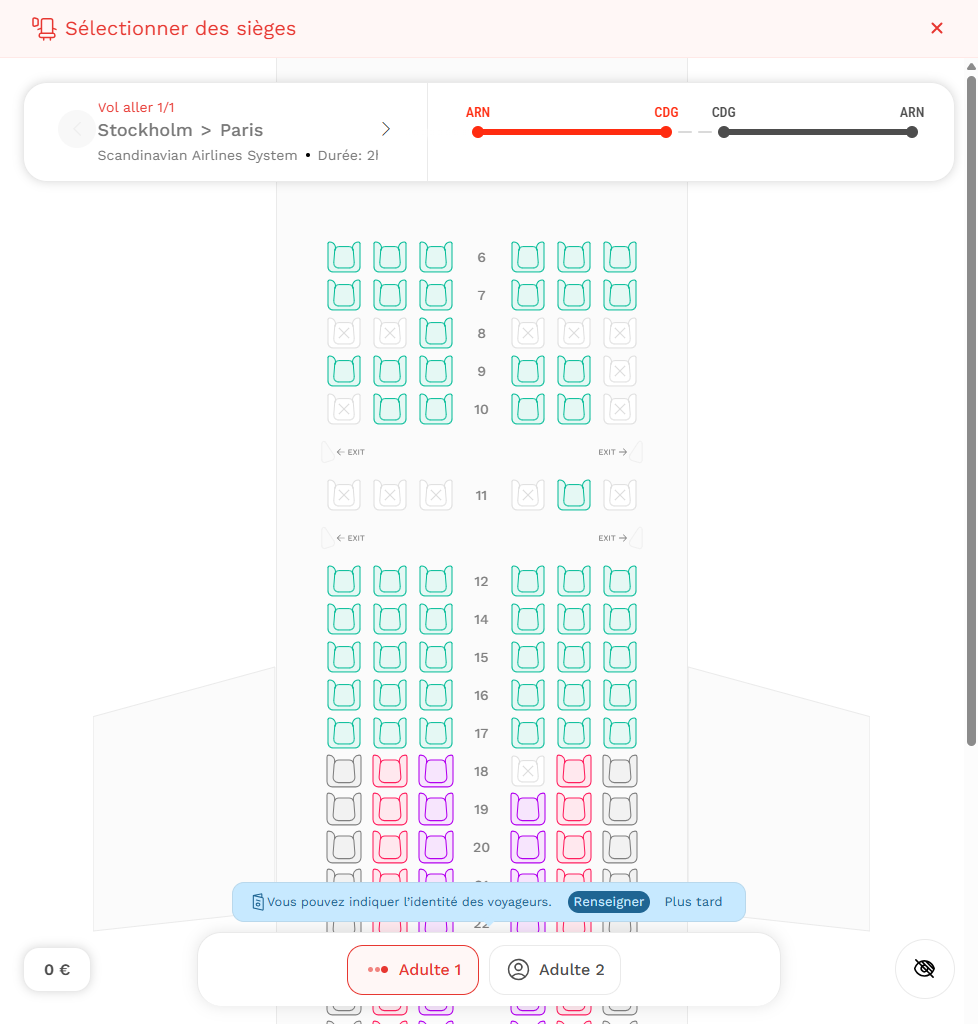
Seat selection via cabin layout

Seat selection via cabin plan is now available in the Dry Transport booking process for Latam Airlines Chile, Avianca , SAS Airlines, Singapore Airlines, TAP Air Portugal, This is available to all passengers on all the segments concerned !

Seat select:

Seat map activation configuration

A new configuration has been implemented for more precise management of Seat Map activation. If required, it enables the cabin map display to be deactivated, while still allowing seat selection when this option is offered by the airline. Activation or deactivation can now be managed independently in each airline’s connectivity settings.

Sending an e-mail following a KO from the reservation process

Travel agencies were not alerted when the airline ticket could not be issued automatically at the time of booking. An e-mail has been added to inform the agency so that it can issue the ticket from the back-office.

Agencies receiving cancellation action summary e-mail

Agencies now receive an e-mail summarizing the cancellation actions taken following a failed booking, including automatic cancellation of reserved items.

The “Payment facilities” module can now be displayed in agent channels

An evolution has been implemented to enable more refined management of ‘payment facilities’, with the aim of improving the user experience, particularly for call center agents. Call center agents can now more easily communicate the amount of the deposit on a quotation, without having to calculate it manually. It is now possible to set up a channel, organization or target user for the ‘payment facilities’ module, as well as defining its display on the payment page.

Deployment of the new secure internal Single Sign-On

The Gifted, Tracer, Transport Aggregator, Jobs, Dashboard Performance modules have been adapted to use the new secure internal Single Sign-On. This enhance security and homogenizes access to the platform with the other modules already integrated.

Add payment-free booking functionality to the indirect sales process

It is now possible to confirm a booking without payment in an indirect booking process. This feature dissociates the reservation from the payment, and is an alternative to payment on account.

Technical cancellation of an indirectly booked in-house product

In-house products can be automatically canceled by the producer following an unsuccessful indirect booking.

Non-VAT information in the Back-office files

Information on the amount exclusive of VAT is now visible in the file estimate from the Back-Office. This amount is automatically calculated and entered in the price lines added following a file modification, regularization or estimate adjustment.

Open/close capability on merged products

The availability update mechanism has been improved. It is now possible to activate a mode in which the closed availabilities of a merged product will not be reopened following the update of its component products. This allows producers to preserve the merged product settings to avoid unwanted bookings.

The Performance Dashboard is integrated for all 3 profiles: supplier, producer, distributor.

This evolution makes the dashboard accessible to all stakeholders (internal, TO and distributors), adapting its operation to each profile via parameters.

Application deployment and monitoring / multi instance on Performance Dashboard

Implementation of application monitoring and session management for multi-instances (cache, properties and configurations).