Application of the RGAA – Lot 1
The RGAA (General Accessibility Improvement Framework) has been implemented in the booking process in several areas: images, frames, colors, tables, links, mandatory elements, and structure.


The RGAA (General Accessibility Improvement Framework) has been implemented in the booking process in several areas: images, frames, colors, tables, links, mandatory elements, and structure.
Security improvements have been made to access the Orchestra Catalog API. Only explicitly authorized applications can access it. All this while ensuring consistent error management. The goal is to improve the quality and robustness of the Catalog API to make it more reliable.
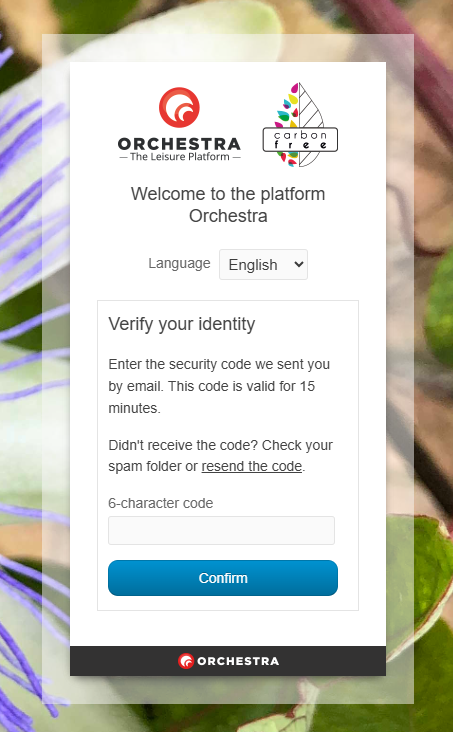
The existing platform login module allows for simple authentication using a username and password. Until now, no secondary mechanism was available, which posed a risk in sensitive access contexts.
In order to strengthen security for accessing the Orchestra platform, a two-step authentication (2FA) mechanism based on the validation of an OTP code received by email has been introduced. This feature can be enabled globally and cannot be customized by the user.
Implementation of application monitoring and session management for multi-instances (cache, properties and configurations).
This evolution makes the dashboard accessible to all stakeholders (internal, TO and distributors), adapting its operation to each profile via parameters.
The Gifted, Tracer, Transport Aggregator, Jobs, Dashboard Performance modules have been adapted to use the new secure internal Single Sign-On. This enhance security and homogenizes access to the platform with the other modules already integrated.
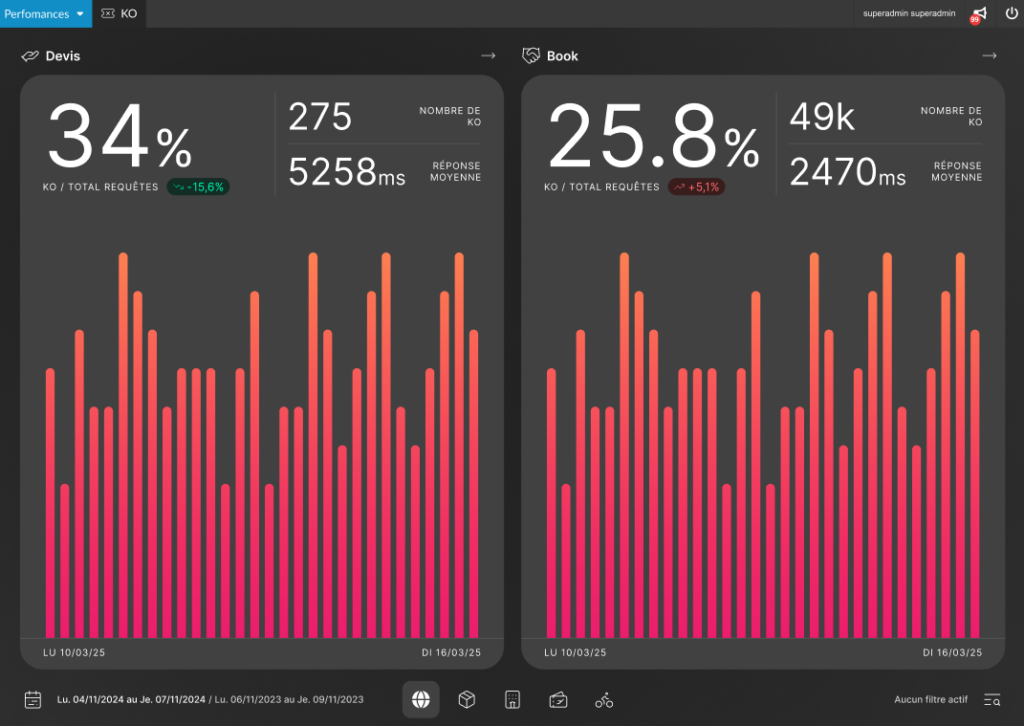
A new dashboard has been created to monitor failed quotes and bookings across the entire distributor and producer catalog. This tool provides a clear and detailed view of errors, facilitating corrective actions and optimizing sales by reducing these incidents. This module can be activated through a configuration.
An upgrade of the SSO connection, via an auto-login API, enables travel agents to connect to the Orchestra platform with the same credentials they use within their internal business environment, in order to access and perform actions in the Advantages module.
We have strengthened the security of our applications, and in particular:
Technological migration to higher-performance systems continues in the background of visible developments. More and more of the platform’s modules are gradually being migrated to these new systems.
For this version 22.6, our teams have been working on the reservation module.
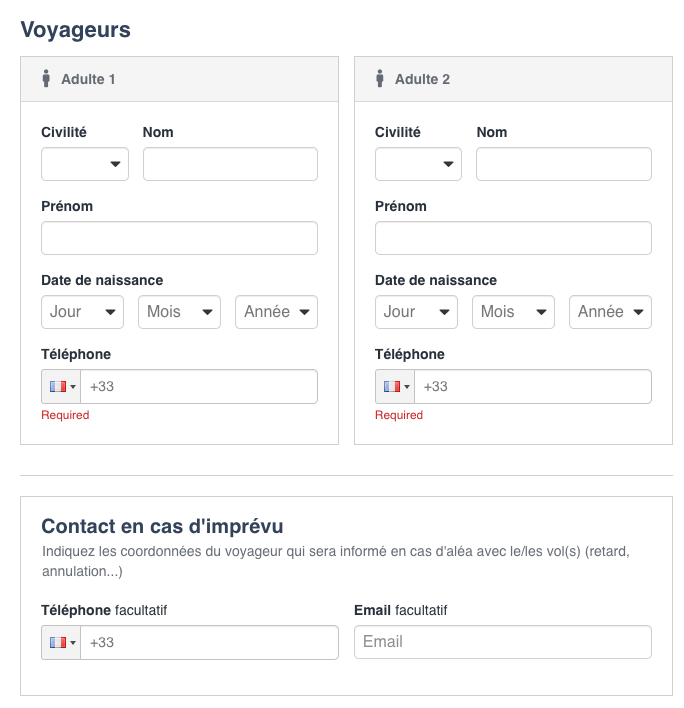
In its resolution 830d, the International Air Transport Association (IATA) specifies that travel agencies must provide passengers’ contact data (telephone number and/or e-mail) in bookings, to enable the producer or carrier to contact customers in the event of unforeseen circumstances (strike, cancellation, flight delay).
Entry and transmission of contact data is now managed on the Orchestra platform and for certain air transport sources.
Entry of the telephone number or e-mail address is managed in the booking process and in the back office.
The transportation sources supported for this feature are Amadeus and Transavia.
The functionality can be activated via the booking configuration and connectivity.
We have taken advantage of this development to improve and standardize the format of the number entered in the existing “Phone” fields in the booking process. This new format is activated by default for all customers, and can be set (deactivated) as required via a reservation configuration.
For security reasons, customer account connection history is now only kept for a maximum of one year.
We have made an evolution to reinforce the security of connections between platform modules, by not storing user credentials in the HTML front office.
The modules concerned by this evolution are the following: Administration, Back office, B2B products & reservations, Pricing management, Accounting, and Partners.
This feature is activated by default and can be deactivated via configuration.
To improve the analysis of payment errors, we have added a tracking in the statistics databases.
We have upgraded the Orchestra Platform and in particular its Identity Management and Access Management system to enable SSO connectivity compatible with the SAML2.0 standard.
Access management to the platform can therefore be handled by a distributor’s system allowing the same users and passwords to be used to connect to the distributor’s tools and to Orchestra.
A list of critical actions are now traced in order to be able to find the time stamp of the action, the account of the user connected and the content of the action.
Here is the list:
Following various penetration tests and security audits, evolutions and improvements have been made to further increase the security of the platform.
Within the framework of the RGPD, the user management functionality has evolved in order to facilitate the setting up of nominative user accounts.
For this, two new rights have been added:
Users with this right will be able to manage all users. Several users will be able to have this right (previously only the highest level user could).
Users with this right will be able to administer all users of their branch. Several users can have this right. This right will allow for example branch managers to manage their agents.
! Important !
Following the version upgrade, you must appoint, via a Jira request, a person in charge at your company to whom the “Global Administrator (manage all users)” right will be granted on the recipe and production environments.
It is important that this person uses a nominative account
Once this request Jira processed by Orchestra teams, this person will then have the ability to manage the accounts of other users, and appoint other administrators.
This step seems essential to us to support you in the best possible management of your users, and on the compliance with the RGPD.
Various developments have improved the security of internal tools and the reservation process. A constant effort of monitoring and improvement is provided, both from a machine and hosting point of view by the Operations teams and from a software point of view by the development teams.
The Tracer tool is the analysis tool of the “logs” of the Orchestra platform, that is to say the written traces left by the various algorithms and programs to allow the understanding and analysis of their actions retrospectively

Before this evolution, the analysis of payments was done via the raw log files of connectors and the booking process. The integration of this new type of file into Tracer allows for an improvement in the efficiency of the teams when analyzing these files.
In addition, PSP errors have been “typed”, which improves the depth of the analysis.
As part of the gradual evolution of the volumes of exports from users of the Orchestra platform, optimisations have been put in place to reduce the memory load of these exports and increase their efficiency.
The customer data anonymization algorithm has been enhanced to improve efficiency and maintenance.
Various evolutions aiming at improving the security of the systems have been brought during this version 19.1
A work of standardization and redesign of the technical emails, alerts and notifications was carried out in order to improve their readability and presentation.
The algorithm for updating the prices of stays produced via Orchestra (prepackages) has been improved to be more efficient, faster and thus support the increase in volumes of availability managed by distributors / producers Orchestra.
The modules “Airplane switch”, “Capping” and “Advantages” have been worked to allow a perfect integration into the navigation within Orchestra.
You will no longer be asked to enter your login details if you are already connected to Orchestra.
The Administration tool will switch to a new technical architecture from this version 18.0. This new architecture allows a better maintainability and more flexibility in the deliveries.
The Jobs instances are technical tools to automate all the processing performed periodically on the data in the Orchestra platform. They are the ones that periodically apply filters on products, manage exports, etc…
These central systems have been migrated to a new technical environment allowing for greater administrative flexibility and performance. This technical migration gave rise to major optimization work.
Within the framework of the continuous technical evolutions on the Orchestra platform, a particularly important project is in progress to allow the delivery of the websites in a transparent way for the Internet users.
Some sites are already using this new technology and have been able to experiment with the delivery of new functionalities in the middle of the day, without interrupting service and without impacting the sites’ ability to take reservations from Internet users.
The editorial contents of all products are stocked in databases on which important updates are made in this version.
Creation of PDFs by different modules of the platform is now centralised using a single system. This centralised management will allow greater efficiency in the optimisation of different internal documents and those for end customers.
Work on the substantial technology migration to better performing systems is continuing behind the scenes of visible developments. More and more of the platform’s modules are gradually being migrated to these new systems.
During this version 17.0, the team has worked on the Administration module.
Under GDPR, manual anonymisation actions were already possible.
To automate this anomymisation process, a method has been created that enables Orchestra clients who might keep information on their end customers and prospects to set configurable periods determining when all customer information must be anonymised, based on their last booking date for example.
Anonymisation algorithms are deployed continuously in databases to ensure proper data protection compliance without the need for manual interventions.
Hundreds of exports are carried out every day (and particularly at night) by the Orchestra platform. These exports, set at different frequencies, are used to centralise and send data to various different systems (accounting, BI, CRM, production or distribution) in order to complete and archive “real-time” data exchanges for the previous period.
Given the rapidly increasing volumes processed by Orchestra on a regular basis, there is an ongoing need to optimise the algorithms that govern these key functions. In this version, we have worked on different ways to compress these application exports in order to adapt in line with new volumes and new uses.
The project for progressively migrating the platform to a recent version of our technological base is requiring sustained effort, and is progressing well.
Improved password recovery feature when connecting to Orchestra tools.
Password security strengthened by adding a mechanism to protect against brute force attacks.
Improvement of the management of application caches in order to improve management of call peaks when the caches are empty.
Reinforcement of user account and customer account password encryption.
Uniform HTTPS protocol management across the entire platform.
The technical bricks that allow apps to dialogue with the database have been completely reviewed, restructured and the associated technology has been updated.
New caches have been added to improve the recovery performance of product cartridges.
The technical base that manages the different cache systems at the application server level has been completely replaced.
The whole of the platform benefits from this new implementation.
It brings better “scalability” and improved performance.
A new main page presenting the different modules is now available on the platform. It can be accessed via a new URL that provides a unique access point for all modules on the platform.
This page contains a login form similar to other tools.
Once connected, the user can choose the module they wish to access. The number of modules presented depends on the user’s access rights. Clicking on the module allows the user to automatically toggle to the corresponding tool, via SSO.
The next time the user accesses the URL for the main page, the user will be directed to the last module they were connected to, and will not go via the module selection step again. So this page provides several benefits. With this page :
However, you can also configure the settings to view this page each time you access the unique URL. This page then becomes a homepage where users must select the module they wish to use each time they log in.

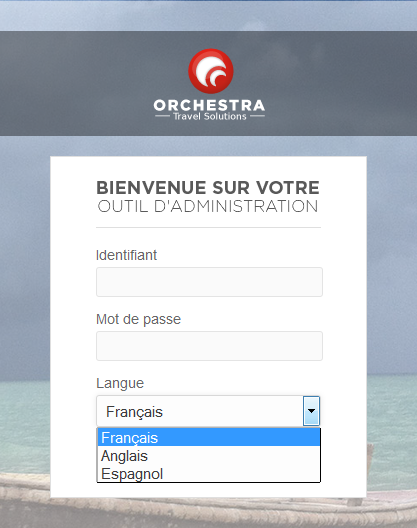
L’ensemble de la plateforme Orchestra est maintenant disponible dans 3 langues : Français, Anglais et Espagnol. Selon la langue sélectionnée lors du login, l’interface s’affichera dans la langue demandée.
Par ailleurs, les devises et le format des nombres affichés dépendent également de la langue sélectionnée lors du login.
La 11.1 est une version qui a fait office de corrections de différents bugs de la plateforme.
Toutes les équipes ont été réunies pour corriger ces bugs en temps restreint.
Un nouveau module de statistiques commerciales est en cours de développement et sera disponible vers la mi-2013. Ces statistiques porteront notamment sur les imports des produits des différents producteurs, l’administration des produits, la navigation sur les catalogues et la navigation dans le tunnel de réservation avec la possibilité d’avoir des informations de benchmarking.
La version 10.4 a été une version courte consacrée principalement à des corrections d’anomalies.
Indicateurs supplémentaires
> Nombre de connexion à chaque instance Jboss
> Mémoire utilisée
> Nombre de connexions base de données Oracle
Suivi en temps réel des ces indicateurs
> Historique de ces indicateurs
Activation du mod_cache
> Mise en cache du contenu statique
> Mise en cache des pages dynamiques
Activation du mod_expire
> Le navigateur du client ne redemandera plus la ressource avant un temps donné
Les Tour Opérateurs et consolidateurs ci-dessous seront intégrés dans les versions à venir :

Pour information, Constellation est une plateforme de distribution de produits touristiques France alimentée par les prestataires eux-mêmes (qui sont les producteurs). Ces derniers ont confié à Constellation un mandat de mise en relation technique avec les distributeurs via Cameleo. La plateforme Constellation permet au distributeur d’accéder à la description des prestations et à des tarifs et disponibilités en temps réel. Constellation se charge aussi de l’encaissement des sommes dues par le distributeur à chaque producteur.
En ce qui concerne weekendesk, il s’agit de séjours à courte durée sur la France notamment.
Par ailleurs, des discussions avec 10 autres producteurs sont en cours pour de possibles intégrations dans les versions à venir.
Cameleo disposera d’un module de compte client. Cela se fera au travers d’une refonte de l’onglet clients de l’outil d’administration et du développement de nouveaux services à intégrer.
Cameleo disposera d’un module d’avis et de notation des experts et des clients. Des processus de validation seront notamment intégrés pour la modération des avis clients
Cameleo sera doté d’une innovation majeure en fin d’année 2009 : la package dynamique. Au-delà de sa forme classique (recherche multi-sources d’hôtels + vols), Cameleo permettra la construction de « Voyages suggérés » dont les tarifs et les inventaires peuvent être sur les sources externes diverses, l’une des sources pouvant être le Tour Opérateur.
Ce module a été conçu dans une optique d’optimisation de la distribution des produits ainsi proposés.
Les nouveaux services suivants ont été mis en place dans le care de la Version 6.2 :
Les Tour Opérateurs ci-dessous seront intégrés dans les versions à venir :

Une trentaine de fonctionnalités sont prévues en version 7.1 dont les suivantes:
La gestion de packaging dynamique est prévue pour la version 7.2 de Cameleo.
Recherche par statut de disponibilité
Nouveau module (option payante) : Interface B2B générique