Internal Hotels / Duplication of a promotion
It is now possible to duplicate a promotion for an internal hotel in the administration module.


It is now possible to duplicate a promotion for an internal hotel in the administration module.
To energize and enrich the catalog of our partner Mevsim Voyages, we have integrated new airline connectivities via Pegasus NDC and Misterfly. This advancement allows us to offer more flexible and varied packages, combining dynamic flights with Mevsim’s existing packages.

Insurance policies produced on Orchestra are changing. It is now possible to set the number of travelers in the file (including infants) with minimum/maximum thresholds. The most relevant insurance policy is then automatically offered to end customers.
In line with the redesign of the administration module, the “Link to a hotel” page now adopts the new Design System style. Changes include:
These optimizations improve the ergonomics and visual consistency of the user journey.
In the administration module, the activity link features have been improved. Configured links are now added to the old ones. This allows you to keep old links while adding new ones. The display has therefore been improved to reflect these new possibilities, which enhance productivity and the readability of the offer to be configured.
Prepackaging module benefits from significant technical optimizations. Instabilities decrease and performance improves. Data volume is reduced.
Cache file blockages now generate automatic alerts. Impacts on prepackage calculations are detected quickly. Collateral damage is thus avoided.
Hotel promotions can now target specific rates. This evolution facilitates dedicated package creation. Distributors benefit from personalized promotions.
Rate-sales channel association is now possible. Mountain catalogs exploit this functionality. B2C and B2B rates are correctly segmented.
Mountain clients require specific booking constraints. Certain dates exclude arrivals and departures. Internal hotel API integrates “close_to_departure” parameter.
To address comprehensive fare policy management needs, Orchestra enhances its support for Travelgate cancellation conditions. The hotel module now integrates fixed amount cancellation fees, which are automatically retrieved from Travelgate and mapped within the Cancellation Management section.
This functionality complements the existing fee types already available (percentage and number of nights), enabling comprehensive and compliant management of all penalties defined in Travelgate.
CroisiEurope additional services (add-ons) now display in optimized chronological order. When dates are identical, longer duration services are prioritized in the display.
Rooms can be deactivated or activated in hotels produced and accessible via the administration module – via channel manager.
A deactivated room will no longer be offered for sale. This makes it possible to manage more precisely what will be offered for sale, without having to delete a room that could be offered again at a later date.
Note that this behavior is automatically synchronized with Travelgate and Orchestra hotels. A room deactivated on Travelgate will also be deactivated on Orchestra.
A new rate added on Travelgate to a room deactivated on Orchestra will have the effect of activating the room.
The availability update mechanism has been improved. It is now possible to activate a mode in which the closed availabilities of a merged product will not be reopened following the update of its component products. This allows producers to preserve the merged product settings to avoid unwanted bookings.
A new feature has been added, allowing the closure of nights by room category (from the Stocks section) rather than by rate plan (from the Planning section).
The Orchestra platform is now connected to the TravelgateX (TGX) platform belonging to the Travelsoft group. This connection enables Orchestra customers to access all TravelgateX Channel Managers easily and more simply. In fact, TravelgateX handles all the human aspects of hotel onboarding (communication, identifiers, setup, etc.), making the process transparent for Orchestra customers.

The option of entering and sending contact details in the event of unforeseen circumstances is now available for all Jetstar airline flights and for all products from producer Maeva.com / La France du Nord au Sud.
Editorial content in different languages is now managed for all the products of the producer La France du Nord au Sud.

Hotel service charges are a mandatory service to book on an MSC Cruise.
These fees are now visible as “Included services” at the quote stage of the MSC Cruise booking process.

Automatic import of price lists for previously created products is now available thanks to our cache file integration module Meteor.
This optimization corrects the following problem: bookings were being made whereas the product availability dates should not have remained open, due to a sliding filter applied to the product. This filter was slow to complete its execution.
The availability search before entering the booking process has been improved to avoid this problem.
In internal hotel management, it is now possible to create rates derived from an existing rate for the same hotel.
This makes it possible to apply an increase or reduction to the prime rate, known as the master rate, either as a percentage or as a fixed amount on the price of the night. For example, it is possible to create a derived rate for a night whose price is equal to 80% of the price of the master rate for the same night.
Only nightly prices are derived from the master rate: commissions, arrival and departure conditions, minimum or maximum length of stay and closures are independent of the master rate.
A new “Maestro” catalog format has been integrated and can be used in product content imports. In particular, it replaces the XFT format for partner Kuoni.
We have upgraded the management of in-house hotels, enabling producers to configure commission at the rate level. Previously, this was only possible by schedule or by date/room.
In pre-package management, it is now possible to filter transport so as to offer either buses or trains in the sales process. Activated via connector configuration.
Il est désormais possible de sélectionner des tarifs lors de la création des pré-packages à partir d’un hôtel interne (ou en connectivité via un Channel Manager/PMS), de telle sorte à ce que seuls ces tarifs sont proposées dans le processus de réservation.
Now, when the switch is configured on a pre-package, all secondary sources are automatically taken into account, including those that will be added later. No configuration will be necessary, this is automatic for all providers connected to the switch.
Restrictions to restrict arrival and departure days are now managed with Reservit channel manager connectivity.
A producer can now request the filtering (and exclusion) of products that are booked “On Request” for his entire distribution.
The geolocation of internal products can now be entered manually in the Administration module.
Two fields Latitude and Longitude are added to the technical information of a product
An evolution of the connectivity with Amadeus now allows to create pre-packages with transport in Open-Jaw for this source (departure or arrival airport different between the outward and return journey).
More and more Orchestra partners and tour operators produce or wish to distribute their catalog to other customers using Orchestra for their distribution.
This feature has been improved to be used in Marketplace mode
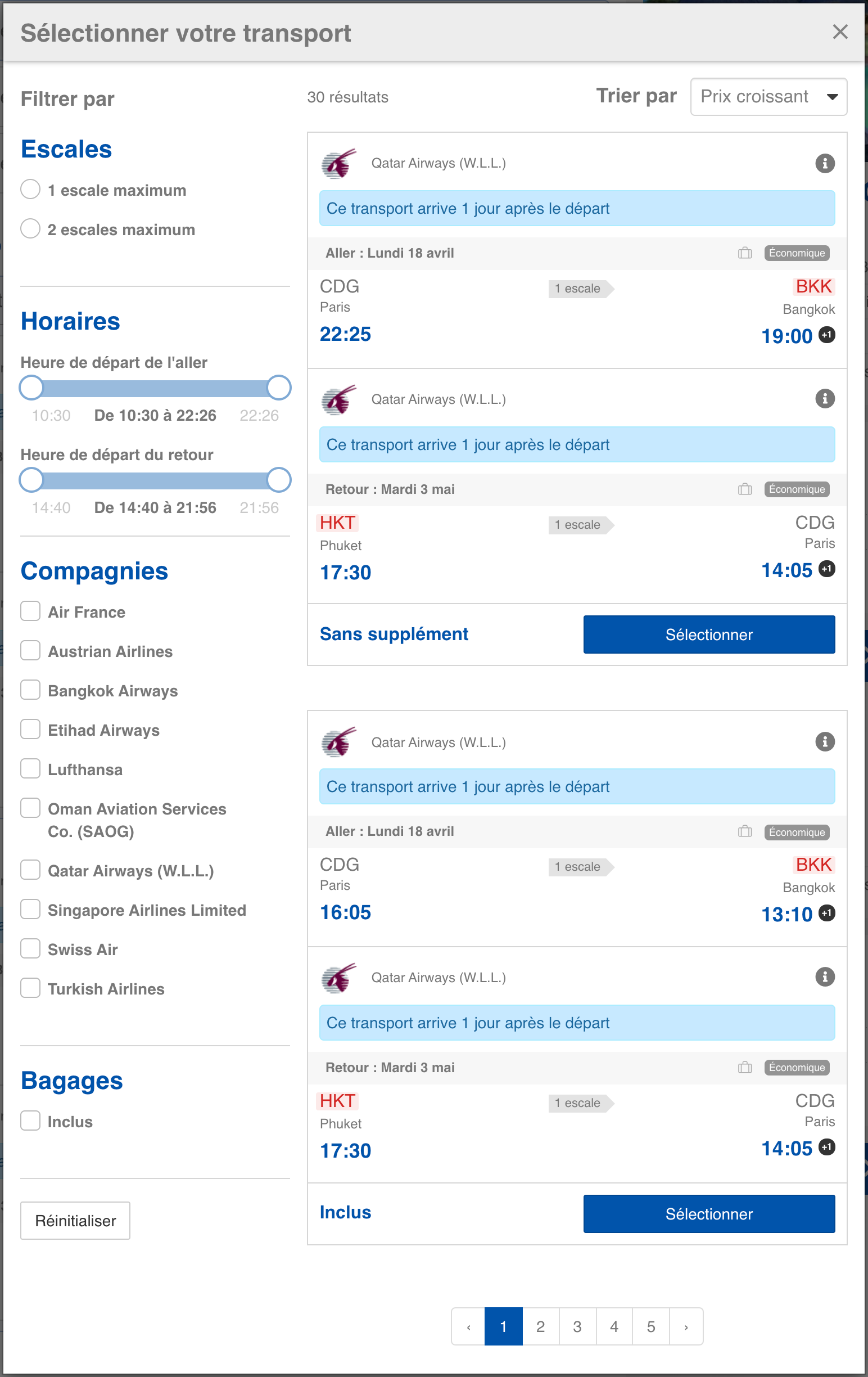
Following the improvements to manage additional baggage and the adjustment of airline wording, it is now available to pre-package with Open-Jaw flights via the Tots flight source (ViaXoft).
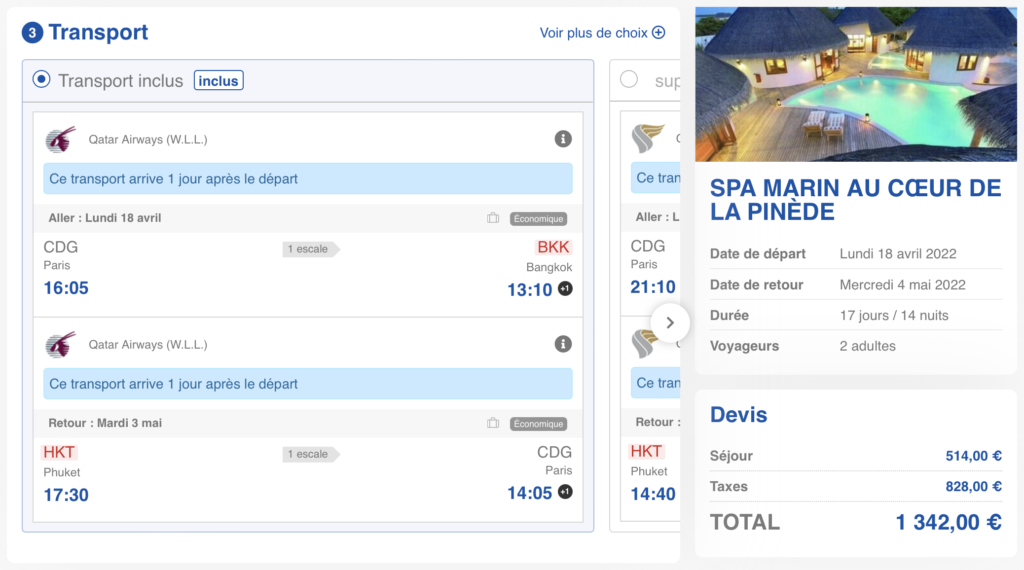
The arrival airport of the outbound flight and the departure airport of the return flight are highlighted with a more dynamic hue to emphasize this particularity of the trip.
The editorial content synchronization system has been modified so that it can also be triggered in the event that content newer than the editorial’s modification date has been imported to the reference product.
The automatic pre-selection of the pre-filling and synchronization functions of the merged products can be customized by distributor via a configuration in order to meet the different use cases of these functionalities.
Factually, these “checkboxes” can be checked by default on the forms or unchecked by default via a configuration.
In order to allow the creation of pre-packages created on the basis of packages whose price is calculated per accommodation (and not in price per person), the loss leader price is now calculated on the basis of the maximum occupancy capacity of the accommodation.
For example, for a pre-package without transport, only containing an apartment for 1 to 4 people at the price of 400€, instead of calculating a price of 200€, calculate a price of 100€.
A new type of price has thus been created (to allow an explicit display on websites in particular): the “price per person for a maximum accomodation occupancy”.
In the case where a pre-package is created from a package without transport, we have added the possibility to quickly speed up the creation of the pre-package by suppressing the entry of periods, dates and durations.
These are automatically taken back from the package without transport.
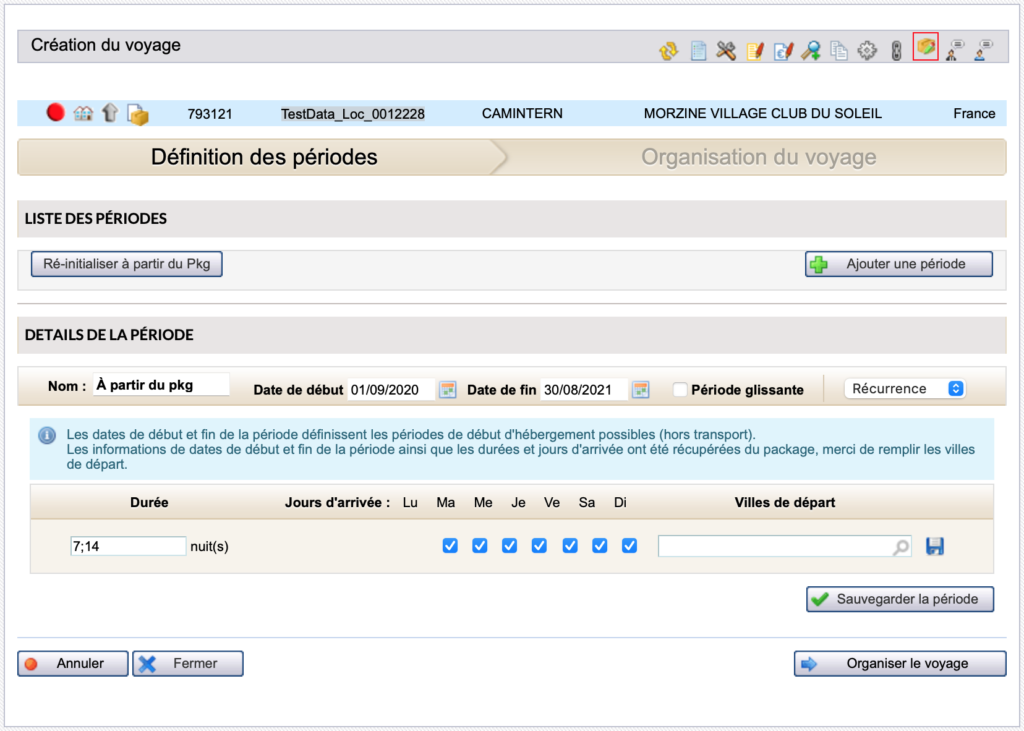
The only information requested to structure the pre-package is therefore the selected departure cities and transportation information.
This evolution allows to synchronize editorial content :
In the case of a merged product, the reference product is chosen in the modal window where the merged product is created. A check bow in this window also allows you to define whether synchronization will be activated or not.
In the case of a prepackaged product, the reference object (hotel or package) is chosen in the last popup of the prepackage management (“organize trip” button). A check box aslo allows to define in this popup if the synchronization will be active or not.
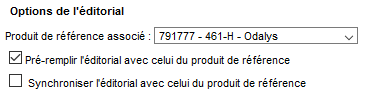
Once the reference element has been chosen, a system will be regularly activated to ensure the synchronization of the editorial content.
It is now possible, via configuration, to add age information and comments from guests in the confirmation email sent to the internal hotel when a reservation is made.
When removing the publication of a merged product is made, it is sometimes necessary to remove the entire sub-products publication.
Via configuration, it is possible to pre-select this functionality as the default option. Depending on the use cases of this feature, this configuration allows to save a click, a bit of time and comfort for users, and reduce the risks of errors.
Dpcache is the plateform’s internal system for calcultating the availability of pre-packages.
The monitoring internal tool for these systems has been improved to enable better monitoring and continuous performance optimization.
It is possible to configure the internal product currency in the mid office. In the case of an indirect booking, when exporting this product to another Orchestra customer, prices are converted from this currency into euros (according to the exchange rate of the day). This distributor will thus be able to sell in euros a product initially built in another currency.
The folders created include the currencies and the necessary information in each of the producer’s and distributor’s systems.
The pre-package availability update algorithm has been improved so that when a pre-package is composed of a sub-package and an availability of that sub-package is closed (for instance due to stock depletion), the availability of the “parent” pre-package is also immediately closed.
The different taxes on flights from the Alltrips source are now accessible, saved and available in the back-office for pre-package products using this flight source.
In the case of pre-packages, an email notification may concern only one of the sub-providers of this pre-package. The notification can be sent to them directly, and no longer sent only to the main provider.
The relevant notification is therefore sent to the contact who can perform the necessary action directly.
Given the increase in the use of several flight sources for the creation of pre-packages, it has become necessary to display the technical source of the flights in the availability details.
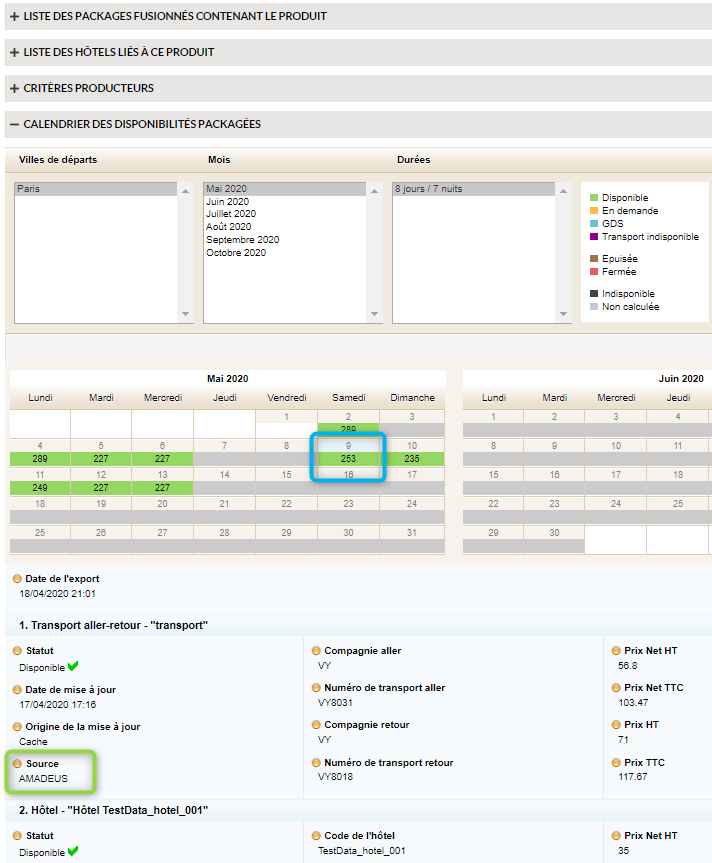
This information is therefore now available by clicking on availability in the calendar section for pre-package availability.
The auto-complete when searching for a transfer to add to the pre-package is now set by the filter for transfer type.

According to the selected transfer type, the auto-complete only displays transfers corresponding to the selected filter.
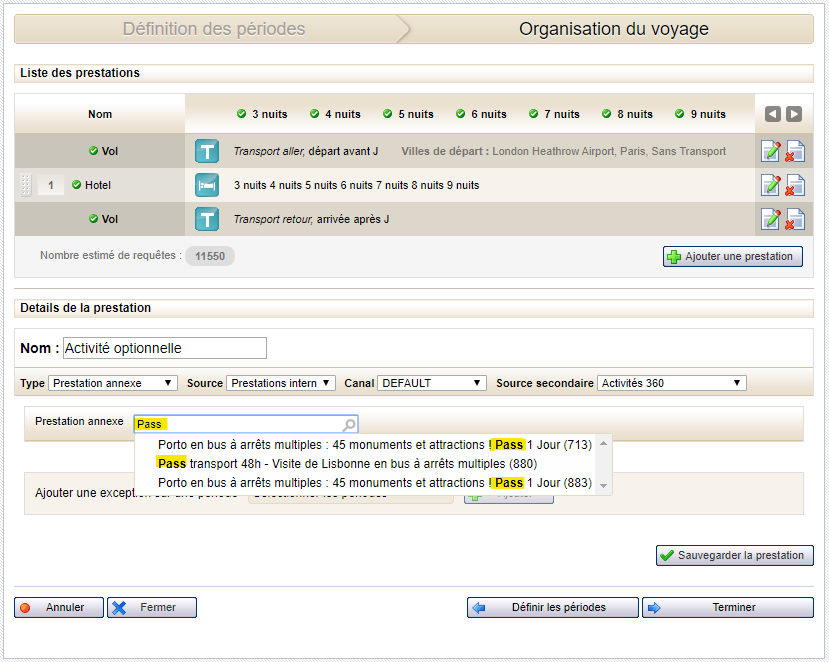
When creating a pre-package structure it was previously necessary to know the code for the service or transfer to link it to the pre-package. This is no longer necessary because there is now a system to auto-complete the code by searching for the title of the item to link.
We have improved the method of calculating the prices and availability of merged products so that updates of these items are only triggered if one of the sub-products has been changed.
This resource-saving measure enables merged packages to be updated more frequently and therefore ensures greater price responsiveness for this increasingly widely used production type.
DPCache is the name of the Orchestra module responsible for calculating the availability of pre-packages. It processes millions of availability options per day and is a central module which numerous in-house staff work on regularly.
To make Producer and Project teams more responsive when credentials need to be changed, it is now possible to edit sources’ credentials directly via the interface.
As part of the production of pre-packages, a system now allows us to update pre-package components directly in the product data in the administration tool without waiting for it to re-import via DPCache.
For indirect bookings, these updates are instantly populated in the producer’s product database and are therefore populated very quickly in distributors’ indirect booking systems.
So that a DPCache update process that starts before the edit that caused the direct population does not overwrite this edit, a system that compares the recency of availability options has been implemented so that the most up-to-date information is always kept.
Following each update of Transport availabilities in DPCache (the internal system used to calculate the pre-package prices), a process updates the prices linked to the modified Transport availabilities. Based on these modified transport availabilities, users search for potential availabilities of transfers and car rentals, which are also included in these pre-packages, in order to arrive at the best base price.
The optimisation has removed 80-90% of calls to Transfers and Car Rental availabilities that were not relevant to the pricing update.
We have made changes to the mechanism used to delete availabilities in the administration tool. If the customer has not changed the structure of the pre-package (and has only modified the periods, for example), it retains the point of intersection between the old and new availabilities created.
If the customer has changed the structure of the pre-package, by default, it will delete all of the old availabilities and re-generate them. However, it is now possible (via a configuration setting) to give the provider the option to decide whether to retain the old availabilities even if the structure is altered.
This means that if the structure is unchanged or if the person creating the pre-package wants to, it is possible to modify a pre-package that is published and available for booking without causing it to become unavailable during the time it takes to recalculate the availabilities.
We have made changes to the pre-package module, adding the function to create a package that combines multiple accommodation bookings.
It is now possible to create rich packages that offer multiple accommodation bookings by combining internal packages (without transport) and an internal hotel or connected via channel managers.
Some examples of use :
For configuration of pre-packages in the administration tool, when duplicating a pre-package, the editorial content associated with the original product can be associated with the new product. The system now also duplicates the settings for the pre-package’s periods and components.
This enhancement saves considerable time for production teams, who now simply need to edit the existing settings rather than configure the entire product from scratch.
It is now possible to add a service by hotel, even if the service does not cover the duration of the stay. These services could, for example, be a special Christmas dinner, which will be displayed if the stay covers the date of December 24th.
Dpcache is the name of the internal system which calculates availabilities (and call prices) for the pre-packages. It calculates millions of availabilities every day, and is a central system for the Orchestra platform.
The alert system has been improved to limit the number of false positives and accelerate responsiveness in the event of a malfunction in the calculation system.
From now on, when you create a Pre-Package from a hotel, it is possible to copy the hotel’s original editorial content so that you can use this information as the basis for the Pre-Package presentation.
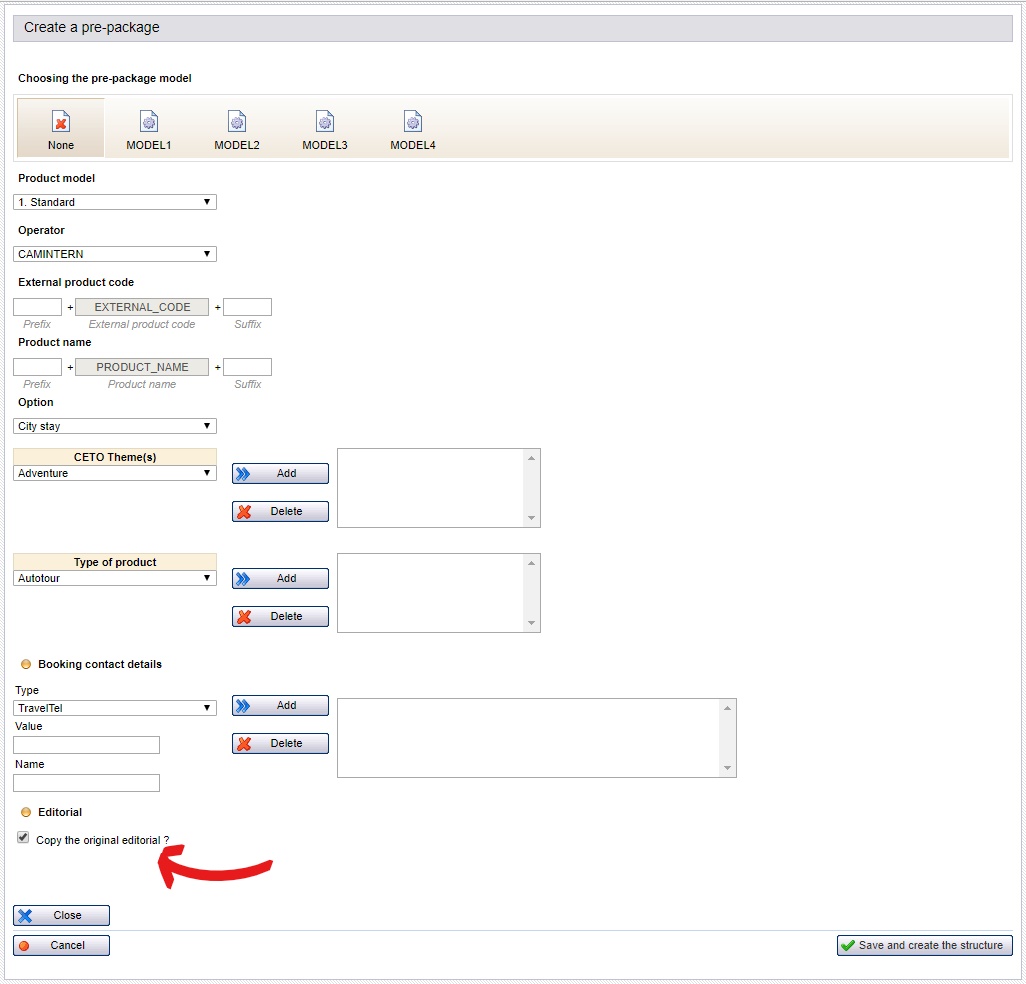
A technical optimisation has been made to reduce the import times for Pre-Package availabilities in the administration tool. The essential method is to supply your various instances of Orchestra only with product availabilities which have been updated by certain events. For example, an automatic update session, a new cache file import).
Drawing upon a number of rules, only availabilities that are likely to have been updated are recalculated. By reducing the number of calculations to be performed, update times are thus reduced and these updates can be made more frequently.
Optimisation of pre-package cache update calculation method These pre-packages are now managed differentially. This latest enhancement reduces caching time for partial modifications of pre-packaged products.
In order to better manage transfers to destinations offering a selection of transportation options (multiple airports and stations for a single destination city), we have added a column for airports or stations to the transfer section.
Display of airport codes in a greyed-out field in the interface for creating a pre-package:
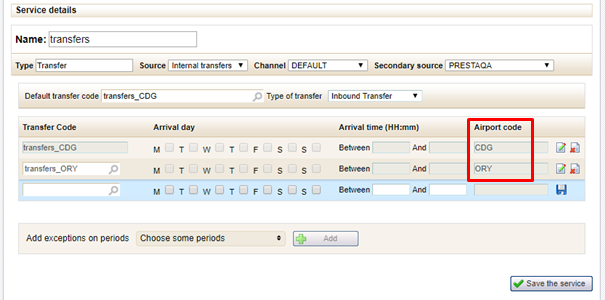
When creating a pre-package, the system will now link your transfer to the arrival (or departure) airport (or station) code, in order to automatically select the right transfer.
As a result, base prices are now also calculated by finding the availability that best minimises the combined price of all package components, e.g. accommodation, transportation, and the transfer associated with the arrival airport or station.
Optimised pre-package cache update calculation methods and the addition of Open-Jaw flight caches. The latter makes it possible to increase the number of cache availabilities for pre-packaged products.
Added technical checks to entered promotions (the ‘duration’ field, in particular) in order to reduce data-entry errors and make this feature more reliable.
Added features to enable commissions included in hotel schedules and for hotel services by default.
New CSV export function for the stocks of internal hotels.
Improved internal hotel stock management whenever there’s little stock available across different room categories.
The option to apply a yield to all non-grouped and internal services has been added.
Why ? So users are informed when booking about the amount of tourist tax they will need to pay once they arrive.
Where ? Entries made in the Orchestra administration tool, ‘hotels’ tab, ‘manage taxes’ action. Within the hotels, dynamic packages and à la carte booking processes, the information will be displayed in a section called ‘taxes not included, to be paid locally’ at the top of the quote page.
How ? Tourist tax can be explained in the form of free text, or in a more structured way by detailing the price per room or pax (adult/child) within the hotel information. The amount can be a set price or a percentage of the price of the room.
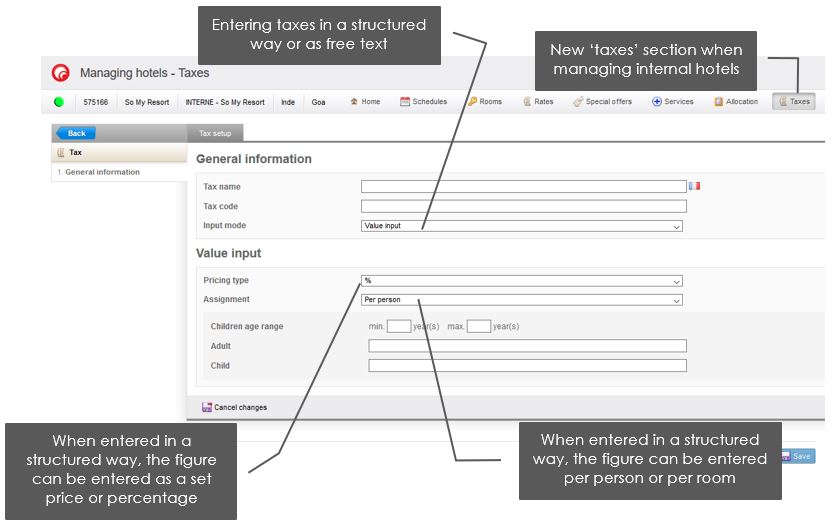
More than one tax can be configured. This is for information purposes only, as they will ultimately be paid locally. An explanatory box, on the quote page, indicates to users the total amount of these tourist taxes to be paid.

This information will be included in confirmation emails.
Why ? In order to help you manage your internal hotels’ cancellation policies more easily in the Orchestra administration tool.
Where ? In the Orchestra administration tool, “Hotels” tab, Action “Rates management”, type of conditions “Flexible”.
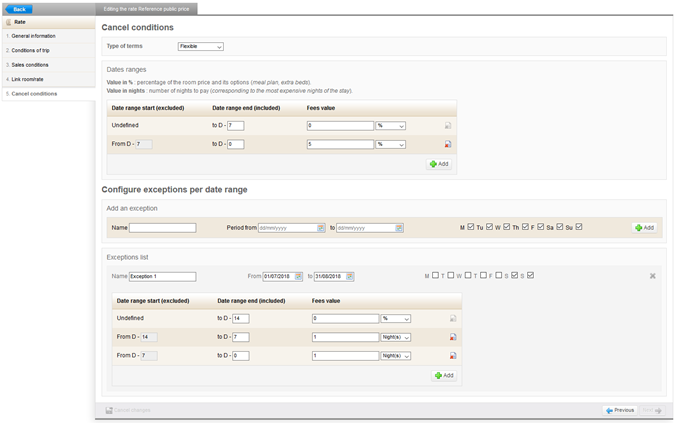
How ? The “Cancellation policies” section allows a list of exceptions to be entered in addition to the main list. Each specific period will overwrite the main period. These periods are defined by :
If the booking is made during the periods defined, the corresponding cancellation policies will be displayed in the booking process as well as in the confirmation email.
In the Back-Office, the calculation of the cancellation fees will also take account of these specific periods.
Improved stock verification in multi-product grids is now available to avoid storing useless information.
Pre-packages containing a flight from an Amadeus source can now use a cache system, which can calculate availability much more quickly, and the refresh rate has been improved.
Il est désormais possible de charger des grilles tarifaires dédiées aux croisières. Le nouveau modèle de grille est téléchargeable dans la section « Documentation ».
1/ Spécificités des disponibilités croisières
Afin de gérer au mieux les choix spécifiques aux croisières, nous avons ajouté plusieurs notions spécifiques au niveau des disponibilités :
Ces trois informations doivent donc être saisies dans la nouvelle grille.
2/ Détails de la nouvelle grille croisière
La grille est très similaire à la grille package. Seules les colonnes dédiées à la gestion du type de cabine / code de la catégorie / code tarifaire sont différentes.
Feuille « Produit » de la grille :
Pour créer des disponibilités, chaque ligne de la feuille « Produit » nécessite :
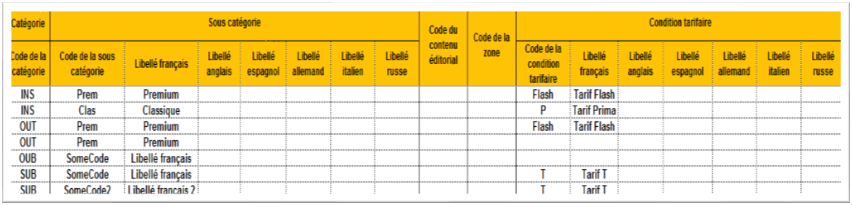
S’il s’agit d’une disponibilité « au départ du port », il faut renseigner la valeur « ZZZ » dans la colonne « Ville de départ».
Feuille “Options” de la grille :
Pour créer une option (obligatoire ou facultative) dans la feuille « Options », le type de cabine, la catégorie et le code tarifaire doivent être les mêmes que ceux de la disponibilité.
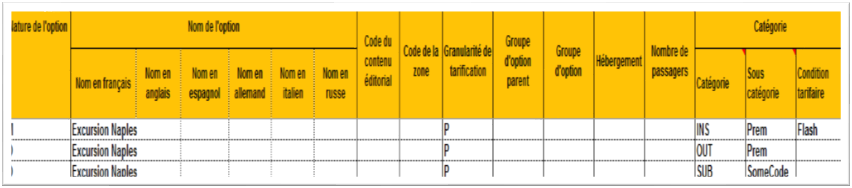
3/ Affichage des disponibilités dans l’outil d’administration
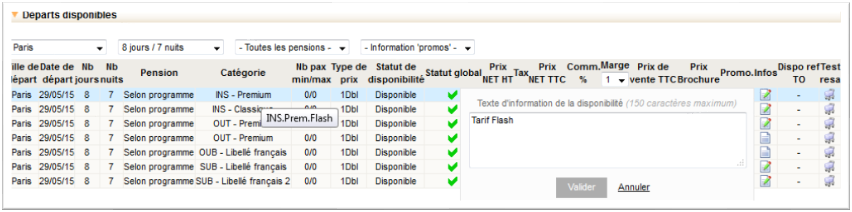
Une fois la grille chargée, les disponibilités catalogue sont visibles sur la fiche produit de l’outil d’administration. Si on laisse la souris sur le libellé de catégorie d’une ligne, on peut voir le code composé des données venant de la grille (Exemple : « INS.Prem.Flash »). C’est ce code qu’il faudra utiliser dans la grille des stocks si l’on souhaite associer des stocks à ces disponibilités.
Par ailleurs, le libellé de la condition tarifaire s’affiche lorsque l’on clique sur l’icône de la colonne « Infos ».
4/ Choix des cabines sur le catalogue
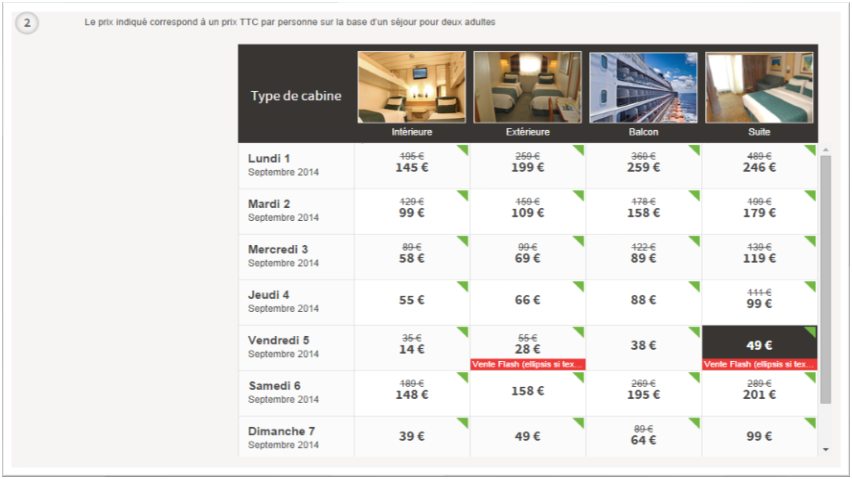
De la même manière que pour les autres croisiéristes compatibles avec les croisières avancées, il est possible d’afficher le calendrier spécifique dédié aux croisières. On peut ainsi sélectionner son type et sa catégorie de cabine directement depuis la fiche produit du catalogue.
5/ Affichage dans le processus de réservation
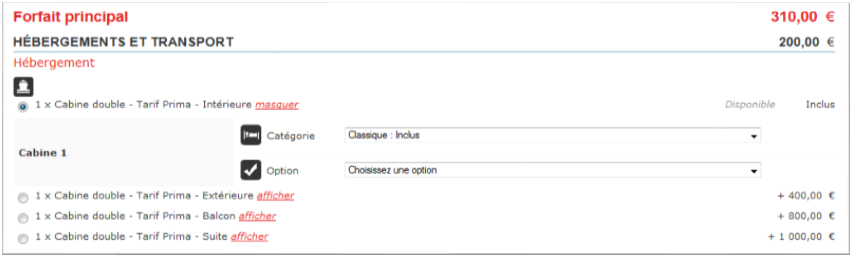
Le choix de la cabine sur le catalogue permet d’améliorer l’ergonomie de sélection des cabines sur la page de devis.
Le premier niveau présente le type de tarif associé ainsi que le type de la cabine (« Tarif Flash – Intérieure » par exemple). Le deuxième niveau permet de choisir la catégorie de la cabine.
A noter qu’il n’est possible de réserver qu’une cabine à la fois lorsqu’on utilise le mode croisière.
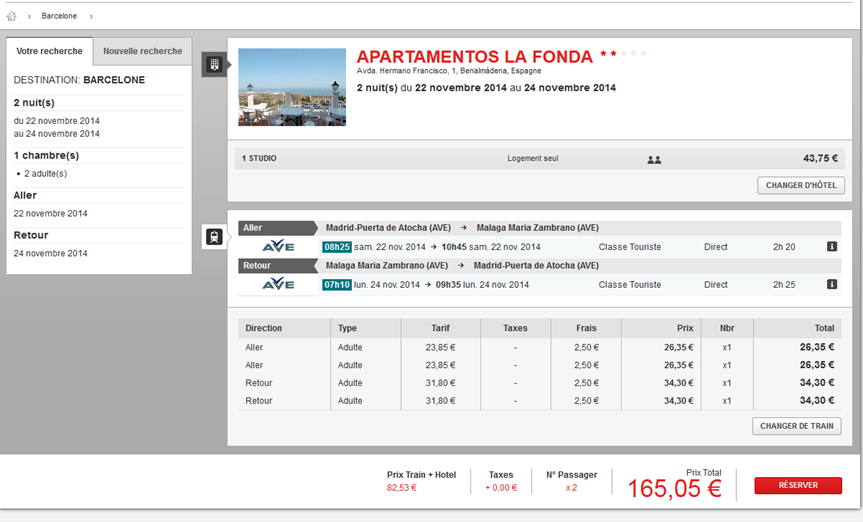
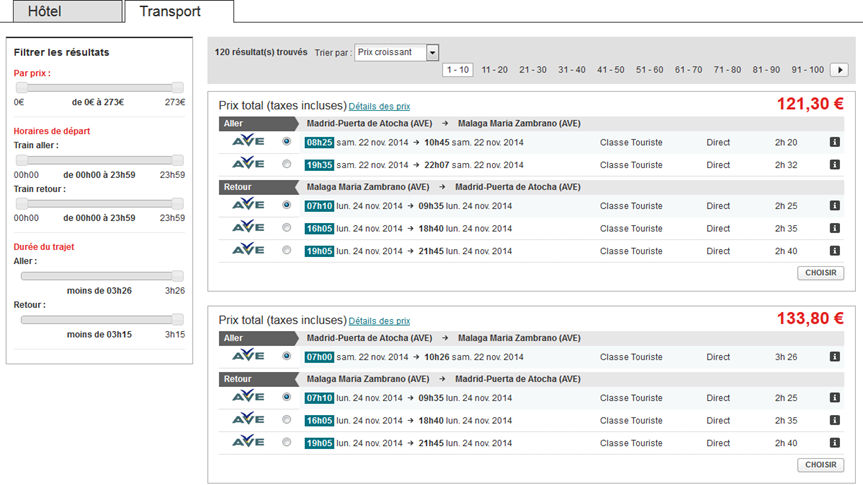
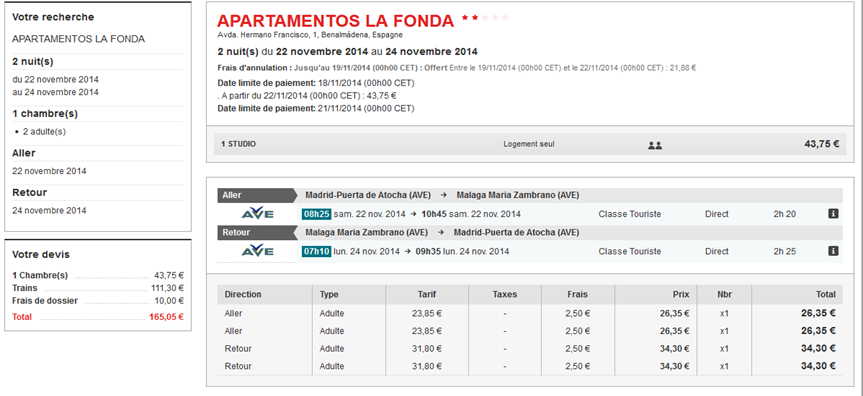
Un processus de vente train + hôtel est désormais disponible. Il fonctionne sur le même principe que le processus de vente vols + hôtels.
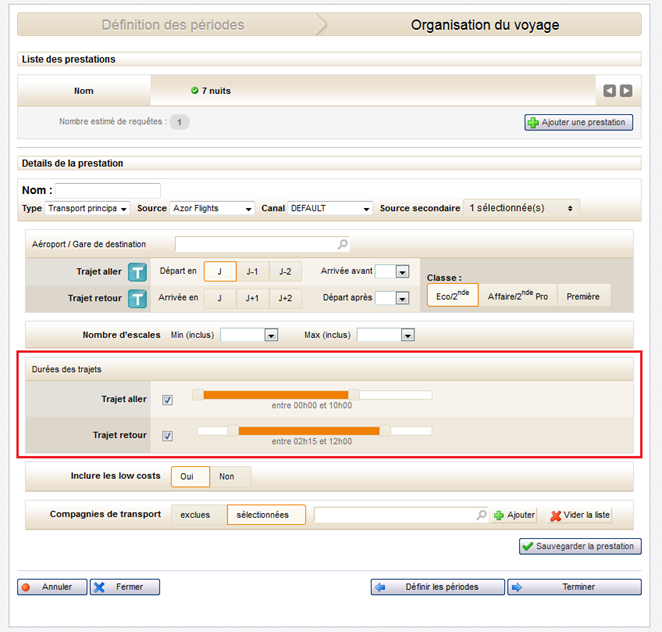
La création de pré-package s’enrichit de nouveaux critères permettant de préciser les caractéristiques des hôtels et des vols à prendre en compte.
Pour les prestations de type vol, le choix de la durée des trajets ont été ajoutés. Les durées du « trajet aller » et du « trajet retour » peuvent être précisées indépendamment avec une valeur minimum et une valeur maximum.
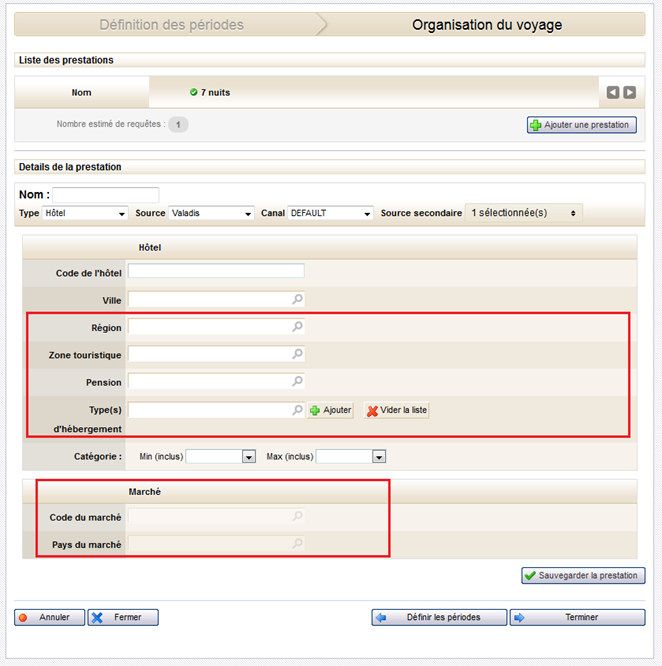
Pour les prestations de type hôtel au sein de la source « Valadis », plusieurs critères ont été ajoutés :
Pour les prestations de type hôtels internes deux nouveaux critères liés au marché de vente ont été ajoutés :
De nouvelles optimisations ont été effectuées afin que les tarifs des pré-packages créés dans l’outil d’administration se calculent et se rafraîchissent plus rapidement. Des caches ont notamment été intégrés afin d’accélérer la remontée des tarifs.
Les producteurs ci-dessous seront intégrés dans les versions à venir :

Les producteurs ci-dessous seront intégrés dans les versions à venir :

Certains produits Visit Europe ne sont réservables que lorsqu’au moins une cure est réservée. Le client ou l’agent est désormais prévenu lorsqu’il essaye de réserver sans cure avec un message spécifique.
Le titre des produits Exotismes comprend désormais le nombre d’étoiles de l’hôtel.
Certains produits d’Ollandini présentent des tarifs par logement (type locatif). Ceux-ci sont à présent signalés comme tels.
Les tarifs basés sur des vols GDS sont également signalés dans l’outil d’administration (« disponibilités GDS »).
Les produits Kuoni sont désormais multi-durées.
Intégration du nouveau fichier de descriptif produit Lagrange. L’utilisation du fichier CETO V2 permet notamment d’importer des informations plus précises sur les produits Lagrange et en particuliers des critères précis du produit (alimentation de la rubrique « critères producteurs » dans l’onglet produit.
Intégration des producteurs suivants :

Il est désormais possible de récupérer automatiquement les documents de voyages pour les dossiers réservés auprès de FRAM.
Le transport de type train est désormais identifié en tant que tel au niveau du processus de réservation pour les produits Théophile paramétrés avec ce type de transport.
Il est désormais possible d’annuler les dossiers directement dans l’onglet dossier de l’outil d’administration avec récupération des frais d’annulation avant annulation pour les producteurs Amplitravel, Climat du Monde, Authentique, Donatello, Flanéo, Gamma Travel, Ollandini, STI, Travel Evasion et Visiteurs.
Les produits Marmara sur ces 2 destinations sont désormais réservables sur Orchestra.
Intégration des 3 producteurs suivants :

Certains producteurs utilisant le système Taranis (ex : Climat du Monde) paramètrent dans le système des informations vols non fiables : les numéros de vols et compagnies peuvent changer après la réservation.
Pour éviter des problèmes après-vente, il est possible de ne pas afficher ces informations au client ou à l’agent sur le processus de réservation.
De manière générale, les catégories de chambre renvoyées par les producteurs sont ordonnées par prix (en dehors de celle sélectionnée par défaut).
Suite à des modifications en liaison avec les imports de disponibilités du producteur, les disponibilités en promo et les disponibilités classiques des produits Nouvelles Frontières et TUI sont désormais regroupées sous un seul et même produit au lieu d’avoir deux produits différents.
Intégration des 4 producteurs suivants :

Les producteurs ci-dessous seront intégrés dans les versions à venir :

Héliades, nouvellement producteur de packages long-courriers, affiche désormais des durées en J+1 lorsque cela est nécessaire.
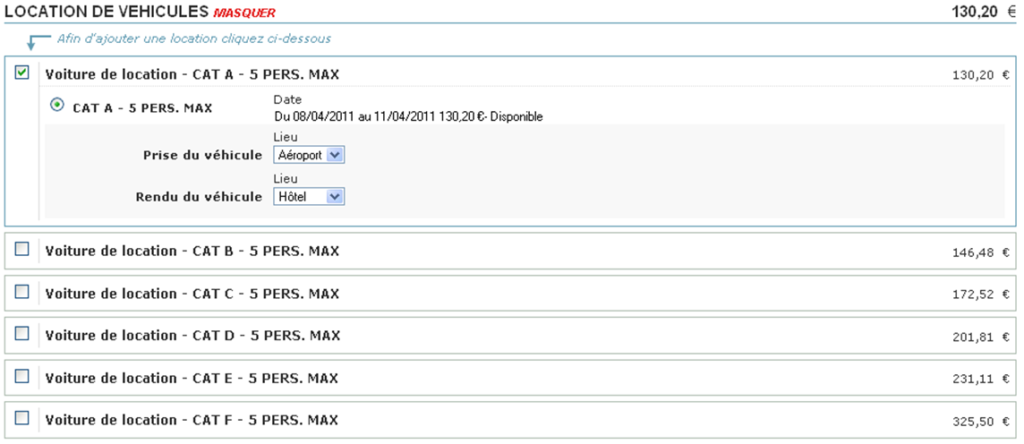
La présentation des prestations de locations de voiture Fram a été améliorée pour permettre une meilleure compréhension du client sur le processus de réservation.
Lorsque le producteur les fournit, les prix brochure sont récupérés pour permettre l’affichage de prix barrés ou pourcentages de réduction sur votre catalogue.
Certaines prestations annexes Lagrange n’étaient jusqu’à présent pas gérées. Suite à l’envoi d’informations supplémentaires par le producteur il est désormais possible de les afficher sur le processus de réservation avec un choix de quantité. Par exemple : Pack ski, forfaits remontées…
Intégration de la production Ollandini, spécialiste de la Corse (avec locations de voitures).

Les producteurs ci-dessous seront intégrés dans les versions à venir :

Un nouveau module de réservation a été développé par le système Iresa pour une gestion plus dynamique des packages.
Les produits de Top of Travel et du Groupe Travelfactory seront ainsi présentés et réservables comme pour les autres producteurs, c’est-à-dire avec des prestations annexes et des transports. Il est à noter que les prix des alternatives de transport et d’option ne sont pas tarifés par le système du producteur lors de la première demande de tarifs. Cela entraîne donc un recalcul nécessaire lors du choix par l’internaute/l’agent. Si le filtre des éléments non tarifés est mis en place sur vos sites / canaux, ceux-ci n’apparaîtront pas pour ces producteurs.
Sur la page devis, l’hébergement inclus par défaut par le producteur est affiché en premier et les alternatives d’hébergements sont affichées ensuite par ordre de prix (ou dans l’ordre donné par le producteur lorsque les tarifs ne sont pas disponibles avant recalcul).
Intégration des 5 producteurs suivants :

Les producteurs ci-dessous seront intégrés dans les versions à venir :

Un certain nombre d’évolutions et de corrections sur la gestion des produits des producteurs existants ont été réalisés en version 7.1.
Certains producteurs n’envoient pas les tarifs de toutes leurs prestations dès la première demande de disponibilité ce qui implique l’affichage d’un bouton ‘Recalculer le tarif’ sur le devis lorsque l’internaute ou l’agent modifie ses choix.
Il est désormais possible de définir pour un producteur si on veut supprimer le ‘mode recalcule’ sur un canal donné. Dans ce cas, les alternatives de pensions, de catégories de chambre et les options non tarifées à la première réponse du producteur seront filtrées afin de présenter un devis sans recalcule et donc un processus de vente plus fluide.
Il est possible d’activer ce filtre pour les producteurs suivants :
L’activation peut se faire par producteur ou pour tous.
Le fonctionnement des autres producteurs n’est pas impacté par cette nouvelle fonctionnalité.
Les produits combinés de Marmara (hôtel+croisière), dont les codes de chambres d’hôtels et de catégories de croisières sont différents, sont désormais réservables via Orchestra.
Quelques exemples de produits : GREATRE3*, GREAMER, GREAILE4*, GREAILE3*, GREATRE4*…
Lorsque les produits présentent des alternatives de vols, celles-ci seront désormais affichées dans le devis pour les producteurs suivants : Visiteurs, Donatello, Amplitravel, STI, Authentique, Travelevasion, Italowcost, Flaneo et Gamma Travel.
Lors du changement dans le choix d’un vol, seuls les vols compatibles complémentaires seront présentés.
Note : les alternatives de vols ne sont pas tarifées lors de la première réponse de disponibilité, ce qui implique l’activation du ‘mode recalcule’ sur le devis. Dans le cas où le mode recalcule est désactivé, les alternatives de vols ne seront pas présentées.
Les fonctions d’annulation / confirmation d’option et la gestion de la date de fin d’option sont disponibles pour les producteurs suivants Visiteurs, Donatello, Amplitravel, STI, Authentique, Travelevasion, Italowcost, Flanéo, Héliades, Gamma Travel lorsque ceux-ci l’autorisent.
Intégration des 7 producteurs suivants :

Les villes de destination hors France sont désormais disponibles sur les produits Camping n°1 lorsque le producteur les transmet.
Les codes utilisés sont les codes Geoname.
A la demande de Marmara, les descriptif des produits en code 2 (promo avec prix net) correspondent désormais aux descriptifs envoyés par le producteur pour les produits en code 1.
Les descriptifs utilisés jusqu’à présent n’était pas toujours corrects en terme de prestations vendues pour les produits en code 2, ce problème est donc résolu.
Intégration des 3 producteurs suivants :

Les Producteurs suivants ont été intégrés :

Ce qui porte le nombre de producteurs intégrés à 39.
Une migration sur la nouvelle plateforme de réservation de Kuoni a été faite au cours de cette version. Cet accès sera paramétrable par canal en fonction de la richesse attendue (proposition d’excursions et possibilité de pose d’option). Dans le cas d’un paramétrage simple, les temps de réponse ont fortement diminués par rapport à la version précédente.
Les optimisations suivantes ont été apportées spécifiquement apportées à Costa Croisières
Les optimisations suivantes ont été apportées sur les Tour Opérateurs suivants:
Des évolutions/corrections sur la gestion des produits des Tour Opérateurs existant ont été faites :
Pour les mêmes Tour Opérateurs, les prestations annexes par dossier, par personne, et par chambre sont gérées.
Intégration des 5 producteurs suivants :

Intégration de l’offre MegaVacances : offre B2B du groupe Karavel/Promovacances, destinée aux agences et distributeurs online.